|
|
| Show All 114 Results (Text Only) |
|
| On Kawara—Silence |
|
| Guggenheim Museum
|
Online exhibit of "On Kawara—Silence." Through radically restricted means, On Kawara’s work engages the personal and historical consciousness of place and time. Kawara’s practice is often associated with the rise of Conceptual art, yet in its complex wit and philosophical reach, it stands well apart. On Kawara—Silence is the first full representation of Kawara’s output, beginning in 1964 and including every category of work, much of it produced during his travels across the globe. Includes videos, and audio tours. See also: Teaching Materials.
Go to Museum Resource: https://www.guggenheim.org/exhibition/on-kawara-silence | |
|
|
| A Picture of Change for a World in Constant Motion |
|
| New York Times
|
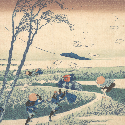
An animated and annotated walk through of a woodblock print by Katsushika Hokusai: “Ejiri in Suruga Province,” from his renowned cycle “Thirty-Six Views of Mount Fuji.” Written in 2020 by Jason Farago, an art critic for the New York Times, the charming and informative annotation and enlarged images provide excellent historical background for this period in Tokugawa history and examples of artistic exchange between Japanese and other Western traditions of the time.
Go to Museum Resource: https://www.nytimes.com/interactive/2020/08/07/arts/design/hokusai-fuji.html?fb... | |
|
|
| Poetic Imagination in Japanese Art |
|
| Portland Art Museum
|
“Poetic Imagination in Japanese Art focuses on one of the great strengths of the Cowleses’ holdings: visual art closely tied to poetic traditions. Poetry, painting, and calligraphy have always been deeply intertwined in East Asia, but in Japan the nature and meaning of those relationships have evolved over time, responding to larger cultural changes. The artworks in this exhibition, spanning the eighth to 20th centuries, illuminate the central role of poetry in the visual arts across time and in diverse social contexts.”
Go to Museum Resource: https://portlandartmuseum.org/exhibitions/poetic-imagination-in-japanese-art/ | |
|
|
| Popular Protest in Postwar Japan: The Antiwar Art of Shikoku Gorō |
|
| Allen Memorial Art Museum, Oberlin College
|
This online exhibit, organized by Oberlin College faculty professor Ann Sherif, situates the art of Hiroshima native Shikoku Gorō in the context of antiwar, antinuclear, and social justice movements from 1945 to 2020. The exhibit guides viewers through the diverse art that Shikoku, in collaboration with grassroots networks of artists & writers, created to promote social justice: guerilla art protesting the Korean War, poems against the nuclear arms race, a children’s book about war, cityscapes critiquing Hiroshima’s wartime past, and recent performing arts that trace this activist history.
Go to Museum Resource: http://scalar.oberlincollegelibrary.org/shikoku/index | |
|
|
| Red Luster (Lacquer) |
|
| The Newark Museum
|
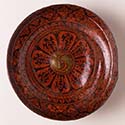
Much of East Asia Lacquer is made from a toxic resin produced by the so-called ‘varnish tree’ (Toxicodendron vernicifluum, formerly identified as Rhus vernicifluum) native to parts of China that also grows in areas of Korea and Japan. Initially, this tree’s resin is processed into a liquid that may be applied over any surface such as woods, metals, cloth, ceramics, baskets, shells, and so forth. To maximize lacquer’s significant protective coating, multiple thin layers are applied and each layer must fully dry before the next is added. Drying is carefully controlled to prevent cracking that would weaken the functional and decorative properties. Raw lacquer dries into a naturally dark color. Adding opaque minerals, such as cinnabar reds (mercury sulfide), orpiment yellows (arsenic sulfate), and malachite greens (copper carbonate) creates colored lacquers. In different processing stages, lacquer can be worked in a variety of techniques.
Go to Museum Resource: https://www.newarkmuseum.org/red-luster | |
|
|
|
| Samurai Warrior Codes: Comparing Perspectives from the Kamakura, Muromachi, and Edo Periods |
|
| Asian Art Museum of San Francisco
|
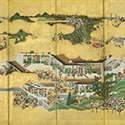
The term, bushido, is often used to describe the samurai warrior code during medieval and modern times. The definition refers to a late 19th century description and was actually quite different than codes from earlier times. Compare warrior codes from different times with the modern definition of bushido. Then, choose which code you think matches the samurai in the screen painting, the Battles at Ichi-no-tani and Yashima, from The Tale of the Heike. Downloads include a Lesson Plan, slide show, and Student Handout.
Go to Museum Resource: https://education.asianart.org/resources/samurai-warrior-codes-comparing-perspe... | |
|
|
| Samurai War Tales: Battle of Awazugahara, from The Tale of the Heike |
|
| Asian Art Museum of San Francisco
|
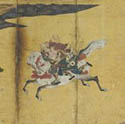
Based on real events from the 900s to 1600s and then embellished over time to create powerful narratives full of good storytelling, sympathetic characters, and poignant and stirring events, War Tales provide information and insights into the lives of Japans warriors. The Tale of the Heike is among Japan’s most celebrated war tales. It traces the rise, brief glory, and fall of the Taira clan (also known as the Heike clan). “This scene illustrates an episode from the chapter 'The End of the Life of Kiso Yoshinaka' in The Tale of the Heike, a thirteenth-century recounting of the wars between two powerful clans, the Heike and the Genji (also called the Taira and the Minamoto).” Also see the video “The Samurai and the Storyteller” and Battles at Ichi-no-tani and Yashima.
Go to Museum Resource: https://education.asianart.org/resources/battle-of-awazugahara-from-the-tale-of... | |
|
|
|
| Show All 114 Results (Text Only) |