|
|
| Show All 110 Results (Text Only) |
|
| Devotion in South India: Chola Bronzes |
|
| Asia Society
|
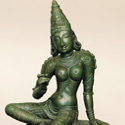
"The tradition of cast-bronze sculptures in the Tamil-speaking region of south India became widely prevalent under the imperial rule of the Cholas, who rose to prominence in the late 9th century at Tanjavur (Tanjore) in the delta of the Kaveri River. These sculptures, mainly created from the 9th through the 13th century, are of the highest quality. Reflecting a new approach to the subject matter, this exhibition considers cast-bronze sculptures in relation to the Hindu tradition of bhakti (devotion), which emphasizes intense and intimate devotion to a personal god. The depiction of itinerant poet-saints among Chola bronzes reflects the importance of these figures in promoting bhakti and the growth of Hindu temples."
Go to Museum Resource: http://sites.asiasociety.org/chola/ | |
|
|
| Educator Resource Packet: Shukongojin |
|
| The Art Institute of Chicago
|
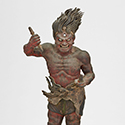
"The Art Institute’s figure of Shukongojin, with his demon-like body, flaring eyes, and mouth stretched in a scream, might have originally terrified an oncoming visitor to the temple he guarded, but might have also instilled a sense of protection and reassurance for the visitor who hoped nothing would disturb his meditations once inside. For the viewer today, Shukongojin looks down from his rock-like pedestal, imposing both a sense of awe and curiosity about the target of his aggressive presence. This teaching packet includes an essay, discussion questions, activity ideas, a glossary, and an image of the artwork."
Go to Museum Resource: https://www.artic.edu/collection/resources/educator-resources/34-educator-resou... | |
|
|
| Exploring Chinese Painting: A Test Module for Undergraduate Teaching |
|
| Columbia University, Media Center for Art History
|
A workspace allowing students to view and compare a group of important Chinese hand scrolls and hanging scrolls from the 10th to the 17th centuries. Uses Flash.
Go to Museum Resource: http://projects.mcah.columbia.edu/nehasian/zoomify/scrolls/swf/start.html | |
|
|
| Exploring the Qingming Scroll: What does an idealized image of society tell us? [PDF] |
|
| The Field Museum
|
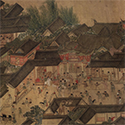
In this lesson plan students will learn about the contradictions contained within the Qingming Scroll and compare it to present-day representations of idealized societies.
Go to Museum Resource: https://www.fieldmuseum.org/sites/default/files/qingming.pdf | |
|
|
| Getting Started with Zazen (Seated Meditation) |
|
| Asian Art Museum of San Francisco
|
In Zen Buddhism, zazen (pronounced: zah-zen) is a sitting meditation. Zazen is not focusing on a specific object or thought. Instead, it is the liberating of one’s mind of all thought into a state of emptiness (a complete emptiness that is also complete fullness) from which the practitioner hopes to experience spontaneous awakening to the inner self (enlightenment). Download Includes a glossary.
Go to Museum Resource: https://education.asianart.org/resources/getting-started-with-zazen-seated-medi... | |
|
|
| Gilded Splendor: Treasures of China's Liao Empire (907-1125) |
|
| Asia Society
|
This excellent interactive website explores the complex cultural and religious legacy of the Khitan and their reign over China during the Liao Dynasty (907-1125). Features an extensive image gallery of objects (organized into the following topics: 1) Nomadic Heritage; 2) Chinese Tomb Tradition; 3) Luxuries and Necessities; 4) Religious Life); an interactive tour of two Liao tombs; plus an interactive map of recently excavated Liao sites in Inner Mongolia (with images); two additional historic maps; and a timeline.
Go to Museum Resource: http://sites.asiasociety.org/arts/liao/ | |
|
|
| Goryeo Celadon |
|
| The Metropolitan Museum of Art
|
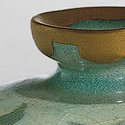
Discusses the development of celadon ceramic production during the Goryeo dynasty (918-1392). With 11 related objects. The term celadon is thought to derive from the name of the hero in a seventeenth-century French pastoral comedy. The color of the character Céladon’s robe evoked, in the minds of Europeans, the distinctive green-glazed ceramics from China, where celadon originated. Some scholars object to such an arbitrary and romanticized Western nomenclature. Yet the ambiguity of the term celadon effectively captures the myriad hues of greens and blues of this ceramic type. During the nearly five centuries of the Goryeo dynasty (918–1392), celadon constituted the main type of ceramics produced on the Korean peninsula.
Go to Museum Resource: http://www.metmuseum.org/toah/hd/cela/hd_cela.htm | |
|
|
| Goryeo Dynasty: Korea’s Age of Enlightenment [PDF] |
|
| Asian Art Museum of San Francisco
|
Few people are aware that the name Korea is derived from the name of the Goryeo (previously tranliterated as Koryo) dynasty. It was during this period (918–1392) that Korea became known to the world outside East Asia. This packet provides an overview of aspects of Goryeo society and Goryeo Buddhism as depicted in the arts of the period.
Go to Museum Resource: https://education.asianart.org/wp-content/uploads/sites/6/2019/12/GoryeoDynasty... | |
|
|
|
| Show All 110 Results (Text Only) |