|
|
| Show All 110 Results (Text Only) |
|
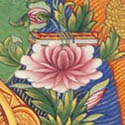
| A Guide to Decoding Buddhist Symbols in Tibetan Art |
|
| Asia Society
|
“Buddhist thangka paintings are visually captivating and impressive — but there is more to them than meets the eye. Thangkas often focus on a specific deity and scene, and their form and surrounding details are often rich with symbolism, turning them into a medium for religious storytelling. Because of this, extracting all the intricacies and meanings from the paintings requires training.” Site has visuals of symbols with annotation on their meaning.
Go to Museum Resource: https://asiasociety.org/new-york/guide-decoding-buddhist-symbolism-tibetan-art | |
|
|
|
|
| Heiji Monogatari Emaki (Tale of the Heiji Rebellion) Scrolls with A Night Attack on the Sanjo Palace |
|
| Princeton University Art Museum
|
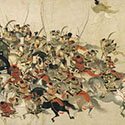
The Heiji disturbance, which occurred late in 1159, represents a brief armed skirmish in the capital. ...The Heiji scrolls date from the thirteenth century and represent a masterpiece of "Yamato" style painting. The scene appearing here, entitled "A Night Attack on the Sanjo Palace," is the property of the Boston Museum of Fine Arts, provides an excellent introduction to the genre of picture scrolls. The scrolls read from right to left, and all action flows to the left. They can be documented as being treasured artifacts in the fifteenth century, when nobles mention viewing them, but they now only survive in fragmentary form.
Go to Museum Resource: http://digital.princeton.edu/heijiscroll/ | |
|
|
| History and Traditions of the Samurai |
|
| Asian Art Museum of San Francisco
|
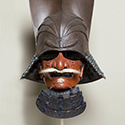
Students will use images of samurai armor and weaponry to learn related vocabulary. They will describe the functional and aesthetic aspects of armor through focused viewing and reading, and they will draw conclusions about the changing code of the samurai over the course of 800 years. Download includes a lesson plan, a number of guides, and slideshows.
Go to Museum Resource: https://education.asianart.org/resources/history-and-traditions-of-the-samurai/ | |
|
|
| Illuminated Manuscripts: The Sacred Art of Narration |
|
| Asian Art Museum of San Francisco
|
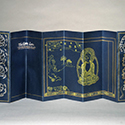
Students will: 1.) Identify the format and elements of a sutra. 2.) Examine why sutras (the teachings of the Buddha) are important historical and religious documents. 3.) Analyze why the writing of sutras is considered an important religious act. 4.) Construct and illustrate an accordion book manuscript based on the sutra format used during the Goryeo dynasty. Downloads include Visual Guides, a Lesson Plan, and Teachers Packet.
Go to Museum Resource: https://education.asianart.org/resources/illuminated-manuscripts-the-sacred-art... | |
|
|
| Imperial Elegance: Chinese Ceramics from the Asia Society's Rockefeller Collection |
|
| Asia Society
|
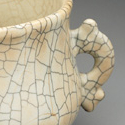
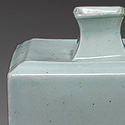
"This exhibition reveals the broad range of aesthetics that appealed to Chinese imperial patrons of Chinese ceramics during a period that spans more than six hundred years, from the Song (960–1279) through the Qing dynasty (1644–1911). Selected works have been grouped to show how color and form in imperial ceramics can provide clues to their function. A final section explores some of the meanings represented by the decorative motifs found on imperial ceramics."
Go to Museum Resource: http://sites.asiasociety.org/arts/imperialelegance/index.html | |
|
|
| In Pursuit of White: Porcelain in the Chosôn Dynasty, 1392–1910 |
|
| The Metropolitan Museum of Art
|
Discusses the ascendance of paekcha, or white ware, during the Chosôn period, including its adoption as imperial ware in the 15th century. With 10 related objects.
Go to Museum Resource: http://www.metmuseum.org/toah/hd/chpo/hd_chpo.htm | |
|
|
|
| Show All 110 Results (Text Only) |